
Heat vs Chemical Bed Bug Treatment | ProHeat Pest Solutions | Southeastern Ohio
Call Us Today!Comparing bed bug heat treatment vs chemical treatment in Southeastern Ohio. Learn which method works faster, safer, and more effectively for complete bed bug removal.
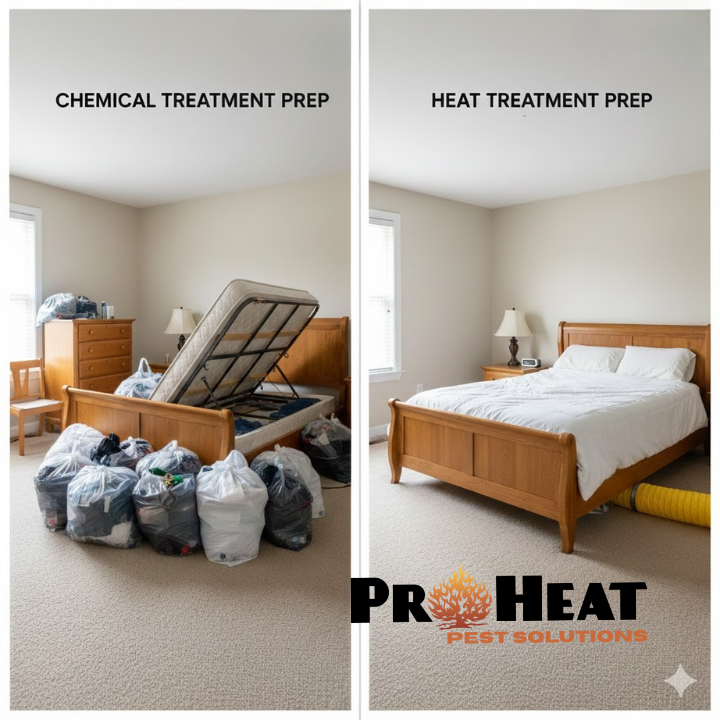
If you're facing a bed bug infestation in Southeastern Ohio, you've likely encountered two competing approaches: bed bug heat treatment and chemical applications. The difference isn't just academic—it's the distinction between a single-day solution and a multi-week ordeal, between killing every life stage in one session and hoping a spray reaches hidden eggs, between walking back into a chemical-free home and managing residue concerns for weeks. Here's the definitive breakdown: bed bug heat treatment uses industrial equipment to raise your home's temperature to 120°F-140°F for 90+ minutes, killing all bed bugs instantly through thermal exposure, while chemical treatment applies liquid insecticides to surfaces, requiring multiple applications over 2-4 weeks to address surviving eggs and nymphs. Both methods can achieve bed bug removal, but they operate on fundamentally different principles—and for homeowners in Athens, Fairfield, Licking, and surrounding counties, understanding these differences is critical to making an informed decision about which bed bug exterminator approach is right for your situation.
The Fundamental Mechanism: How Each Method Kills Bed Bugs
Bed bug heat treatment is a physics-based solution. Professional bed bug exterminators like ProHeat Pest Solutions use industrial heating equipment (such as the GreenTech Titan 800) to elevate the ambient temperature of your entire home—or targeted rooms—to between 120°F and 140°F. At these temperatures, the proteins in bed bug cells denature, causing immediate death across all life stages: adults, nymphs, and eggs. The heat penetrates into voids that human inspectors can't access—inside electrical outlets, behind baseboards, within the hollow legs of furniture, and deep into mattress seams. This is thermal remediation: a complete, structural approach to bed bug removal that treats the environment rather than just the visible surfaces.
The bed bug heat treatment process takes 6-8 hours from start to finish. Your bed bug exterminator arrives, sets up heating units and circulation fans throughout your home, gradually raises the temperature while monitoring with thermal sensors, sustains the lethal range for 90+ minutes to ensure egg mortality, and then allows the structure to cool naturally. You leave in the morning and return by late afternoon to a bed bug-free home—no follow-up visits required, no residual chemicals, no lingering concerns.
Chemical bed bug treatment, by contrast, is a biochemical approach to bed bug removal. A bed bug exterminator applies liquid insecticides (commonly pyrethroids like Crossfire, which contains Clothianidin and Metofluthrin) to baseboards, furniture seams, mattress edges, box springs, and other harborage areas. These chemicals work by disrupting the nervous system of bed bugs that come into direct contact with treated surfaces. The residual protection remains active for 30-60 days, creating a barrier that kills bugs as they move across treated areas.
However, chemical bed bug removal has a critical limitation: it cannot kill eggs. Bed bug eggs have a protective shell that insecticides cannot penetrate. This means that even after a thorough chemical application, eggs will hatch 7-10 days later, producing a new generation of nymphs. To address this, chemical treatments require at least two applications (sometimes three) spaced 10-14 days apart, targeting the newly hatched nymphs before they reach reproductive maturity. Total treatment time: 2-4 weeks, with multiple bed bug exterminator visits and extended preparation protocols.
Speed and Efficacy: One Day vs. Multiple Weeks
For homeowners in Southeastern Ohio—particularly in high-turnover rental markets like Athens (home to Ohio University) or family-oriented suburbs like Lancaster and Newark—the timeline difference in bed bug removal is decisive.
Bed bug heat treatment is a single-day event. ProHeat Pest Solutions schedules your appointment, you vacate for 6-8 hours, and you return to a completely treated home. There are no follow-up visits, no waiting periods for eggs to hatch, and no uncertainty about whether the bed bug removal worked. The heat reaches every bed bug, in every life stage, in every hiding place—simultaneously. For landlords preparing a unit for a new tenant, or parents who need their children's bedroom cleared immediately, thermal remediation is the only method that delivers same-day bed bug removal.
Chemical bed bug treatment requires patience and coordination. After the first application by your bed bug exterminator, you wait 10-14 days for eggs to hatch. The technician returns for a second treatment to kill the newly emerged nymphs. If the infestation was severe, a third visit may be necessary. During this entire period (2-4 weeks), you're managing treated surfaces—keeping children and pets away from baseboards, avoiding direct contact with furniture edges, and mentally tracking whether the bed bug removal is working. Many homeowners in Southeastern Ohio report that the psychological burden of a prolonged chemical protocol is nearly as stressful as the infestation itself.
Preparation Requirements: Minimal vs. Extensive
This is where bed bug heat treatment separates itself from chemical bed bug removal in terms of homeowner convenience.
For bed bug heat treatment, preparation is straightforward: remove medications, aerosol cans, candles, wax products, portable electronics, and sensitive plants. Everything else—clothing in drawers, bedding, stuffed animals, books, furniture—stays exactly where it is. The thermal remediation process treats these items in place. You don't need to bag every article of clothing, strip every bed, or launder every fabric item in your home. For a typical Southeastern Ohio household, this represents a 2-3 hour prep checklist, most of which involves temporarily relocating a few categories of heat-sensitive items.
For chemical bed bug treatment, the preparation burden is extensive. Most bed bug exterminators require you to bag every article of clothing and wash/dry on high heat, strip all bedding and launder separately, move furniture at least 12 inches away from walls, remove or cover all food items, vacuum all carpets and seal the vacuum bag immediately, and disassemble bed frames to allow access to joints and crevices. For a family of four in a 1,500-square-foot home, this preparation process for chemical bed bug removal can take 10-15 hours of labor. Homeowners in Fairfield and Licking counties—many of whom work full-time and have young children—often cite the preparation nightmare as the reason they ultimately choose bed bug heat treatment over chemical methods, even when the upfront cost is higher.
Health and Safety: Chemical-Free vs. Residue Management
Southeastern Ohio families, particularly those in suburban communities like Lancaster and Newark, are increasingly cautious about introducing synthetic pesticides into their living spaces. This concern is especially acute for households with young children, pregnant women, elderly residents, or individuals with asthma or chemical sensitivities.
Bed bug heat treatment is entirely non-toxic. There are no chemicals applied during thermal remediation, no residues left behind, and no off-gassing. The only "byproduct" of bed bug heat treatment is a warm house that cools to normal temperature within a few hours. Children can sleep in their beds the same night. Pets can return immediately. There's no need to wipe down countertops, wash dishes, or re-launder clothing. This makes thermal remediation the preferred bed bug removal method for multi-family housing, hospitality settings, and any environment where occupant safety and rapid re-entry are priorities.
Chemical bed bug treatment requires careful management. While modern insecticides like Crossfire are formulated to be "safe when dry," the application process involves aerosolized particles that should not be inhaled during bed bug removal. Re-entry timelines vary by product (typically 4-6 hours minimum), and treated surfaces remain active for weeks. Most bed bug exterminators advise keeping children and pets away from baseboards and furniture edges during the residual protection period. For homeowners with health concerns, this creates ongoing anxiety about accidental exposure—particularly in tight living spaces where avoiding treated surfaces entirely is impractical.
Coverage and Penetration: Whole-Structure vs. Surface-Only
This is the technical distinction that explains why bed bug heat treatment achieves higher first-treatment success rates in bed bug removal.
Thermal remediation penetrates into voids and hidden spaces. Bed bugs don't just live on surfaces—they hide inside electrical outlets, within the internal mechanisms of alarm clocks, behind picture frames, in the cracks of wooden furniture, and inside the hollow legs of tables and chairs. Chemical sprays, no matter how thoroughly applied by a bed bug exterminator, cannot reach these interior sanctuaries. A technician using chemical methods treats what they can see and access, but bed bugs in wall voids, inside electronics, or deep within upholstered furniture often survive the initial application. These survivors reproduce, and the infestation rebounds within weeks, requiring additional bed bug removal efforts.
Bed bug heat treatment, governed by the laws of thermodynamics, treats the entire environment uniformly. Heat transfer via convection and conduction ensures that every cubic inch of your home reaches lethal temperature during thermal remediation—including the spaces that visual inspection and chemical application miss. This is why bed bug heat treatment is the gold standard for commercial hospitality settings and multi-family housing: it eliminates the risk of partial treatment and subsequent re-infestation, ensuring complete bed bug removal in a single session.
Cost Analysis: Upfront Investment vs. Total Cost of Ownership
Bed bug heat treatment typically costs more upfront—ranging from $1-$3 per square foot depending on the severity of the infestation and the size of the structure. For a 1,500-square-foot home in Southeastern Ohio, expect an initial investment of $1,500-$4,500 for thermal remediation. However, this is a single-treatment cost. There are no follow-up visits from your bed bug exterminator, no repeated applications, and no additional labor costs for preparation or post-treatment cleanup.
Chemical bed bug treatment appears cheaper initially—often $300-$800 for the first application by a bed bug exterminator. But factor in the second application (another $300-$800), the potential third application ($300-$800), the cost of laundering or dry-cleaning every fabric item in your home ($200-$500), and the lost wages from taking multiple days off work for technician visits. The total cost of chemical bed bug removal can easily exceed $2,500-$4,000 over the full treatment cycle, with no guarantee of success.
For property managers in Athens and landlords in Fairfield County, the math is even more compelling. Bed bug heat treatment allows a unit to be cleared and ready for a new tenant within 24 hours through thermal remediation. Chemical protocols require 2-4 weeks of downtime, during which the unit generates zero rental income. The lost revenue from vacancy often exceeds the cost difference between bed bug heat treatment and chemical methods.
Resistance and Efficacy: Why Chemical Treatments Are Failing More Often
Here's a reality that many bed bug exterminators won't tell you: bed bugs in Southeastern Ohio have developed significant resistance to pyrethroid insecticides. The same chemicals that were highly effective in the 1990s now have reduced kill rates because bed bug populations have evolved genetic mutations that allow them to survive chemical exposure, making bed bug removal via traditional methods increasingly unreliable.
Studies conducted by university entomology departments have documented resistance levels as high as 5,000-fold in some populations, meaning it would take 5,000 times the standard dose to achieve the same lethality that was once routine. This is why homeowners increasingly report that chemical bed bug removal "didn't work"—not because the bed bug exterminator did a poor job, but because the bed bugs themselves are biologically resistant to the active ingredients.
Bed bug heat treatment is immune to this problem. Bed bugs cannot develop resistance to thermal remediation. The thermal death point is a fixed biological constant: when bed bug proteins denature at 118°F-120°F, the insect dies, regardless of its genetic makeup. This makes bed bug heat treatment the only bed bug removal method with consistent, predictable efficacy across all bed bug populations.
If You're in Southeastern Ohio, Here's How to Choose the Right Bed Bug Removal Method
At ProHeat Pest Solutions, we offer both bed bug heat treatment and chemical options because we understand that every infestation is different. When you call us at 740.418.0105, we'll start with a K-9 inspection using Zeb, our award-winning beagle, to map the extent and location of your infestation with 90%+ accuracy. This diagnostic precision allows us to recommend the most effective and cost-efficient bed bug removal strategy for your specific situation.
We recommend bed bug heat treatment if you: need immediate, same-day bed bug removal (landlords, property managers, families with young children); have health concerns about chemical exposure (pregnant women, asthmatics, pet owners); want guaranteed results without follow-up visits; have a moderate to severe infestation requiring thermal remediation; or live in Athens, Fairfield, Licking, or surrounding counties and value speed plus safety.
We recommend chemical treatment if you: have a very limited, isolated infestation (e.g., a single piece of furniture); are on a tight budget and can manage the multi-week timeline for bed bug removal; are comfortable with the extensive preparation and re-entry protocols; and have no health sensitivities to insecticides.
For most homeowners in Southeastern Ohio, bed bug heat treatment delivers the best combination of speed, safety, and guaranteed efficacy for complete bed bug removal. It's a single-day solution using thermal remediation that treats your entire home uniformly, requires minimal preparation, leaves no chemical residue, and works regardless of bed bug resistance levels. When Gary Johnston and Zeb arrive from ProHeat Pest Solutions to conduct your bed bug removal, you're getting a scientifically superior method backed by industrial equipment and local expertise from an experienced bed bug exterminator.
If you're dealing with bed bugs and want to understand which treatment method is right for your home, call ProHeat Pest Solutions at 740.418.0105. We'll provide a free consultation, conduct a K-9 inspection to map your infestation, and deliver a customized bed bug removal plan—whether that's bed bug heat treatment, chemical treatment, or a hybrid approach. We serve all 15 counties in Southeastern Ohio with professional thermal remediation services, and we're committed to getting you back to sleeping soundly in your own home as quickly and safely as possible.
You might also like