
Do I Need to Leave During Bed Bug Treatment? | ProHeat Pest Solutions
Call Us Today!Wondering if you need to evacuate during bed bug treatment in Southeastern Ohio? Learn the timeline, safety protocols, and what to expect with heat vs. chemical methods.
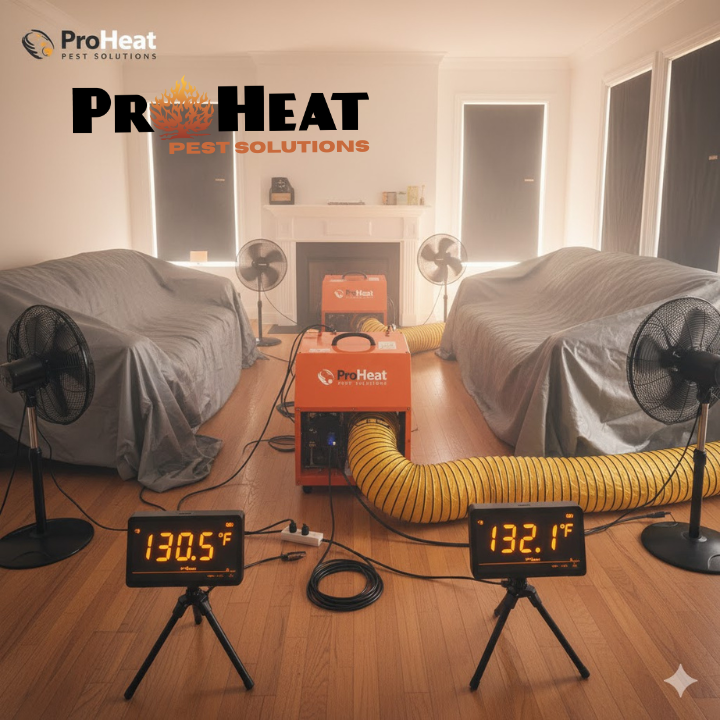
If you've confirmed bed bugs in your home, one of your first logistical questions is likely this: Do I need to pack up the family and leave? It's a fair concern—especially when you're already dealing with the stress of an infestation, lost sleep, and the mental burden of knowing something is living in your mattress. The answer depends entirely on the bed bug treatment method your bed bug exterminator uses. But here's what you need to understand upfront: yes, most professional bed bug removal services require temporary evacuation, but the duration and reason vary significantly between bed bug heat treatment and chemical applications.
The Direct Answer: Heat Treatment vs. Chemical Treatment
For bed bug heat treatment—the method ProHeat Pest Solutions specializes in—you'll need to vacate your home for approximately 6 to 8 hours. This isn't because the treatment itself is dangerous to humans or pets; heat treatment is entirely non-toxic. The reason is simple physics: we're raising your home's internal temperature to between 120°F and 140°F, which is lethal to bed bugs at all life stages but also uncomfortable and potentially unsafe for occupants. Think of it like turning your entire house into an industrial oven for the day. You'll leave in the morning (typically by 8 AM) and return by mid-to-late afternoon (around 4 PM), once the structure has cooled to a safe, livable temperature. There's no chemical residue to worry about, no lingering odors, and no need to rewash your linens or wipe down surfaces. You simply walk back into a bed bug-free home.
For chemical-based bed bug removal, the timeline is more variable and the restrictions are stricter. Most chemical applications require you to leave for 4 to 6 hours minimum while the product dries and ventilates. However, the preparation and post-treatment protocol can extend this significantly. You may need to bag all clothing, strip bedding, and remove pets for an extended period. Some residual insecticides, like those containing pyrethroids or neonicotinoids (e.g., Crossfire), remain active on surfaces for weeks, which means avoiding direct contact with treated baseboards or furniture edges until fully absorbed. If you have young children, pets, or anyone with respiratory sensitivities, the precautions multiply. Chemical bed bug treatments also typically require follow-up applications 10 to 14 days later, meaning multiple evacuation cycles.
Why Bed Bug Heat Treatment Offers a Cleaner, Single-Day Solution
In Southeastern Ohio, where housing stock ranges from historic brick homes in Athens to modern builds in Fairfield and Licking counties, bed bug heat treatment has become the preferred method for homeowners who value speed, safety, and certainty. The reason is straightforward: heat penetrates into the voids that chemicals can't reach. Bed bugs hide in electrical outlets, inside the hollow legs of furniture, behind picture frames, and within the internal mechanisms of alarm clocks. A liquid spray applied to visible surfaces will never reach these sanctuaries. Heat, governed by convection and conduction, permeates the entire structure uniformly. The GreenTech Titan 800 and similar industrial heating systems used by professional bed bug exterminators create an environment where there is literally nowhere for a bed bug to survive.
This is particularly critical in areas like Athens, where Ohio University student housing creates high turnover and frequent reinfestation risks. Landlords can't afford the 3-week cycle of a multi-application chemical protocol when a new tenant is moving in. A single day of bed bug heat treatment provides a documented, verifiable clearance—something that makes ProHeat Pest Solutions the go-to bed bug exterminator for property managers across the region.
What to Do While You're Away During Bed Bug Treatment
Here's the tactical reality: you're going to have 6 to 8 hours to fill during your bed bug heat treatment. Plan ahead. If you're in Lancaster or Newark, consider this a forced day trip—take the family to Hocking Hills, visit the Columbus Zoo, or simply spend the day at a local café with a good book. If you have pets, they'll need to come with you (most veterinarians in the region can board animals on short notice if you need a drop-off solution). Plants that are sensitive to heat should be removed, along with any medications, candles, or aerosol cans that could be affected by prolonged high temperatures. Your bed bug exterminator will provide a detailed prep list, but compared to the extensive bagging and laundering required for chemical bed bug treatments, heat prep is remarkably minimal.
One advantage that's often overlooked: you don't need to wash everything after bed bug heat treatment. Your pillows, stuffed animals, clothes still in drawers—they're all treated in place. Chemical methods often require washing or dry-cleaning every fabric item in the home, which is not only time-consuming but also expensive. For a family of four, that's easily 10+ hours of laundry and $200+ in dry-cleaning costs. With bed bug removal via heat, you skip all of that.
The Safety Question: Is Bed Bug Heat Treatment Really Non-Toxic?
Let's address the concern that brings many homeowners to bed bug heat treatment in the first place: chemical exposure. Southeastern Ohio families, particularly those in suburban Fairfield and Licking counties, are increasingly cautious about introducing synthetic pesticides into their living spaces. This is especially true for households with young children, pregnant women, or individuals with asthma or chemical sensitivities. Bed bug heat treatment eliminates this variable entirely. There are no residual toxins, no need to keep children off treated carpets for days, and no risk of pet exposure. The only "byproduct" of heat treatment is a slightly warm house that cools naturally within a few hours.
This is also why heat treatment is the preferred method for multi-family housing and hospitality—there's no liability risk associated with chemical exposure claims, and tenants can re-enter immediately once the temperature normalizes. When you hire a bed bug exterminator who specializes in thermal bed bug removal, you're choosing a method that protects both your family's health and your peace of mind.
What Happens If You Don't Leave During Bed Bug Treatment?
This is a question we occasionally get, usually from someone trying to minimize disruption or who is skeptical about the bed bug removal process. Do not attempt to stay in your home during a bed bug heat treatment. Sustained exposure to temperatures above 100°F can cause heat exhaustion, dehydration, and in extreme cases, heatstroke. Professional bed bug exterminators monitor ambient temperatures throughout the treatment using thermal sensors, and those readings will exceed safe human tolerance for extended periods. This isn't a negotiable safety precaution—it's a hard requirement for any responsible bed bug heat treatment.
For chemical bed bug treatments, the risk is different but equally serious. Many insecticides are neurotoxins designed to disrupt the nervous systems of insects, and while they're formulated to be "safe when dry," the application process involves aerosolized particles that should not be inhaled. Re-entry too soon can result in headaches, nausea, or respiratory irritation—complications that bed bug heat treatment avoids entirely.
If You're in Southeastern Ohio, Here's How ProHeat Pest Solutions Makes Bed Bug Removal Seamless
At ProHeat Pest Solutions, we've streamlined the evacuation process because we understand that logistics matter—especially when you're already stressed about bed bugs. When you schedule a bed bug heat treatment with us, we provide a clear, hour-by-hour timeline. You'll know exactly when to leave, what to take with you, and when it's safe to return. Gary Johnston, who leads every bed bug treatment personally, coordinates with you the day before to answer any last-minute questions. If you're uncertain about whether a specific item (a guitar, a laptop, a family heirloom) can withstand the heat, we'll walk you through it.
We also offer K-9 detection with Zeb, our award-winning beagle, as a pre-treatment service. This ensures we're only heating the areas that actually need bed bug treatment, which can reduce both the time and cost of the service. For homeowners in Athens, Fairfield, Licking, or any of the surrounding 15 counties we serve, this combination of precision and transparency is what sets us apart from the "spray and hope" approach of larger, less specialized bed bug exterminators.
Final Thoughts: Why Bed Bug Heat Treatment Is Worth the Brief Evacuation
The temporary inconvenience of leaving your home for 6 to 8 hours is a small price to pay for complete bed bug removal in a single day. Unlike chemical bed bug treatments that require multiple visits, extensive prep work, and prolonged exposure risks, bed bug heat treatment offers a faster, safer, and more definitive solution. You're not just hiring a bed bug exterminator—you're investing in a scientifically proven method that eliminates every life stage of the pest, from eggs to adults, without leaving a single trace of chemicals behind.
If you're dealing with bed bugs and need a treatment that respects your time, your health, and your peace of mind, call ProHeat Pest Solutions at 740.418.0105. We'll give you a free quote, a clear timeline, and a guaranteed result—so you can get back to sleeping soundly in your own home.
You might also like